Calculator Grant budgeting
MTDC is a subtraction, and that is where budgets go wrong
Almost every grant budget template adds costs up. The hard part of a federal budget is the taking away — working out which costs are excluded from the base your indirect rate applies to. Get the subtraction wrong and you either leave money behind or claim money that comes back at audit.
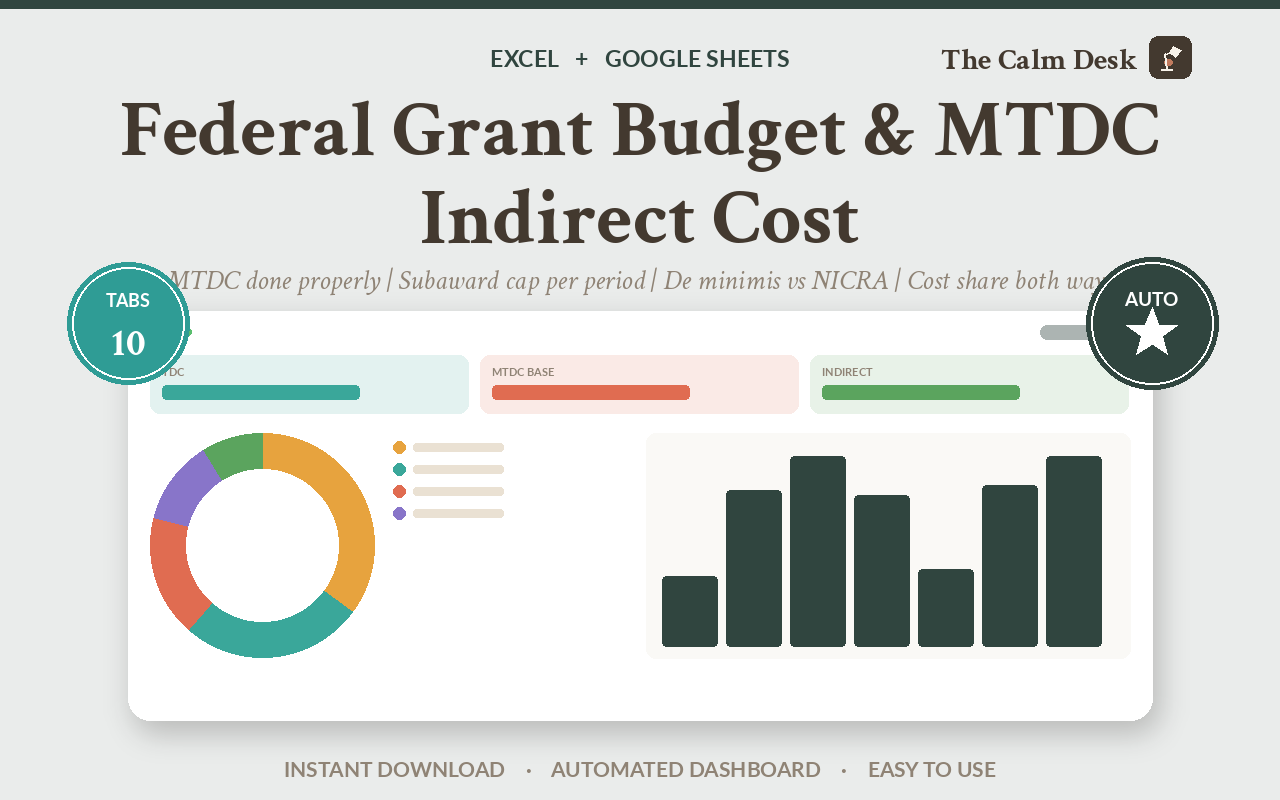
Modified Total Direct Cost is your total direct costs minus certain categories: equipment, capital expenditure, patient care, rental costs, tuition remission, scholarships, participant support — and the portion of each subaward above a cap. Your indirect rate applies only to what is left.
Three parts are consistently done wrong. The subaward cap runs per period of performance, not per year. Equipment is tested against the capitalisation floor per unit, not per line. And a cap expressed as a percentage of total cost is a margin, not a markup.
Why a subtraction is harder than an addition
Grant budgets have two layers. Direct costs are the things you can point at — salaries, travel, supplies. Indirect costs are the share of keeping the lights on that this project ought to carry, and you recover them by applying a percentage rate.
A percentage of what, though? Not of everything. If it were, an organisation could inflate its indirect recovery just by buying an expensive machine or passing a large chunk of the work to somebody else — neither of which creates much administrative burden for them.
So the rules define a smaller base: total direct cost, minus the categories that would distort it. That is MTDC, and it is a subtraction.
Subtractions are harder to get right than additions, because every excluded category has its own rule, and none of them are obvious. A template that adds a budget up cannot tell you it got the base wrong — it will produce a confident, tidy, incorrect number.
Three errors, and what each one actually costs
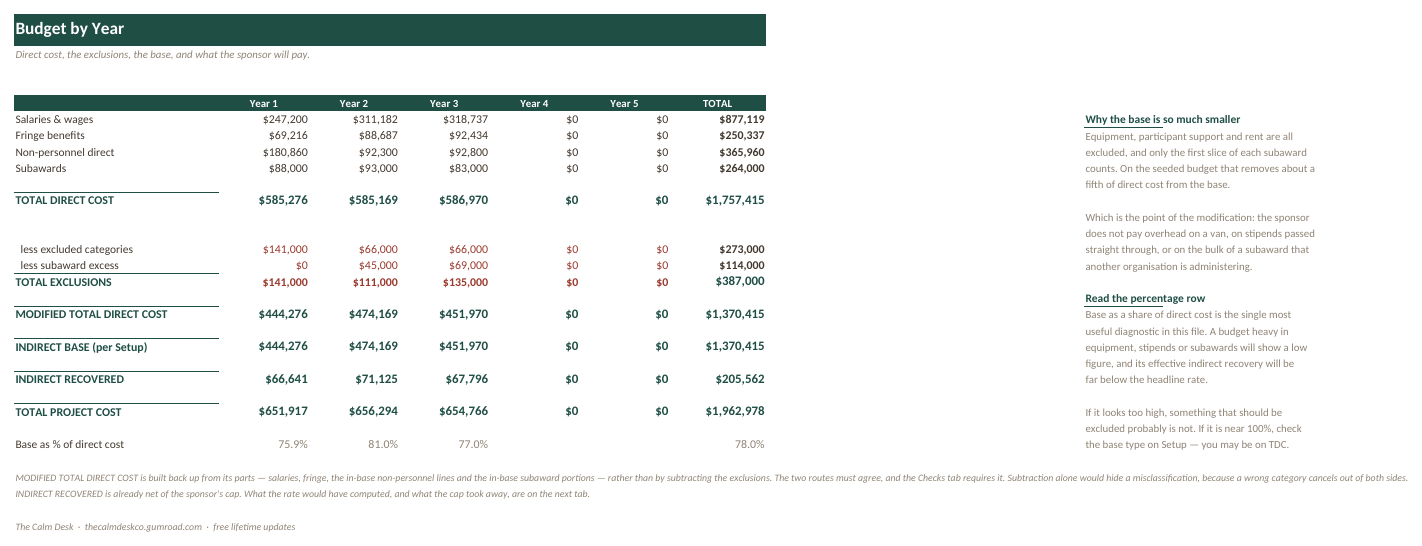
On the seeded three-year award — $1,757,415 of total direct cost, a $1,370,415 MTDC base — here is what each of the three common errors does. Note that they do not all point the same way.
| Error | Base moves by | Recovery moves by | Which direction |
|---|---|---|---|
| Subaward cap applied per year instead of per period | +$114,000 | +$17,100 | OVER-CLAIM — comes back at audit |
| Equipment tested by line total instead of per unit | −$8,160 | −$1,224 | Money left on the table |
| Still using the pre-2024 $25,000 subaward cap | −$75,000 | −$11,250 | Money left on the table |
The first one is the dangerous one. It increases your recovery, which means nothing in your own review will flag it — you get more money and everything looks fine, until an audit takes it back.
The other two cost you money quietly. Twelve tablets at $680 each are an $8,160 line, but equipment is tested per unit against the capitalisation floor, and $680 is well under it — so they are supplies, and they stay in the base. Treating the line total as equipment removes $8,160 you were entitled to claim on.
Why the subaward cap is the hard one
Only the first slice of each subaward counts toward MTDC. The rest is excluded. The part people get wrong is when that slice is consumed.
The cap runs across the whole period of performance, not per year. It is consumed in the order the money goes out:
in base, year y = MAX(0, MIN(spend in year y,
                             cap - everything spent in earlier years))
So a subaward spending $80,000 in year one has already used the whole cap; nothing in years two or three counts. Apply the cap per year and you count it three times over.
The three subawards in the sample data cross the cap in three different years, deliberately, so the fill is genuinely exercised rather than accidentally correct:
How to build the MTDC base correctly
Add up the total direct cost
Everything first, categorised. On the sample award this comes to $1,757,415.
Test equipment per unit, not per line
Twelve tablets at $680 are an $8,160 budget line and they are not equipment. The regulation tests per-unit acquisition cost against the capitalisation floor, so they are supplies and they stay in the MTDC base.
Getting this wrong removes $8,160 from your base and $1,224 from your recovery, for nothing.
Fill each subaward's cap across the whole period
in base, year y = MAX(0, MIN(spend_y, cap - spent in earlier years))Per period of performance, not per year. The workbook also checks the year-by-year fill against a closed form — the total in base must equal MIN(total spend, cap) — so the arithmetic is verified two independent ways.
Subtract the other excluded categories
Each has its own definition and each is a straight exclusion. On the sample award the exclusions total $387,000, leaving an MTDC base of $1,370,415 — 78.0% of total direct cost.
Apply the rate, and handle any cap as a margin
% of DIRECT cost -> allowed = rate x direct
% of TOTAL cost  -> allowed = direct x rate / (1 - rate)
12% of total cost is 13.6% of direct cost. This is the same margin-versus-markup shape that
appears in the bid calculators and in recipe costing, and it turns up a third time in cost share:
federal x r/(1-r), not federal x r.
What is inside the file
Ten tabs — the most of anything here, because the exclusions each need their own working. Seeded with a three-year award whose three subawards cross the cap in three different years.
| Tab | What it does |
|---|---|
| Start Here | What to fill in, in what order, and how to import the file into Google Sheets. |
| Setup | Period of performance, indirect rate, subaward cap and capitalisation threshold — all inputs, because all three moved in 2024. |
| Personnel | Salaries and fringe by person and by year. |
| Non-Personnel | Travel, supplies, equipment and everything else, with equipment tested per unit. |
| Subawards | Each subaward, with the cap filled in the order the money goes out across the whole period. |
| Budget by Year | The full budget with the MTDC base and indirect recovery calculated per year. |
| Indirect Comparison | De minimis against a negotiated rate, with any cap applied — so you can see what negotiating is actually worth. |
| Cost Share | Matching requirements, including caps expressed on total rather than federal cost. |
| Checks | Independent verification of the base, the cap fills and the totals. |
| How It Works | Every exclusion rule and every formula, written out. |
Opening it in Excel, Google Sheets or Numbers
It is one .xlsx file. There are no macros, no add-ins and nothing to install, which is what makes it portable — a macro-driven template would be Excel-only.
| App | How to open it |
|---|---|
| Microsoft Excel | Double-click the file. Excel 2016 and later, and Microsoft 365, on Windows or Mac. Nothing to enable and nothing to install. |
| Google Sheets | Go to Google Drive, click New → File upload and pick the .xlsx. Then double-click it in Drive and choose Open with → Google Sheets. To keep a native copy, use File → Save as Google Sheets. Formatting and formulas both carry over. |
| Apple Numbers (Mac, iPad, iPhone) | Numbers opens .xlsx directly — double-click it, or in Numbers use File → Open and select the file. Numbers converts it on open and will list anything it changed. To send a copy back to someone on Excel, use File → Export To → Excel. |
| LibreOffice Calc | Free, and opens the file as-is on Windows, Mac and Linux. This is what I use to recalculate every workbook when I check the maths, so it is the app these files are tested hardest in. |
Every formula in this workbook uses ordinary functions — SUM, IF, INDEX, MATCH and their relatives. Nothing here is Excel-only.
Get the workbook
$89 one-off · no subscription
- One .xlsx file, ten tabs, works in Excel, Google Sheets, Numbers and LibreOffice
- A three-year sample award with subawards crossing the cap in three different years
- Subaward cap filled per period of performance, verified two independent ways
- Equipment tested per unit against the capitalisation floor
- De minimis versus negotiated rate comparison, with caps applied as margins
- Thresholds as inputs, because all three changed in 2024
- Free lifetime updates
Instant download from Gumroad. A budgeting tool, not compliance advice. Confirm current thresholds for your award.
The arithmetic, written out
MTDC = total direct cost
     - equipment, capital expenditure, patient care, rental,
       tuition remission, scholarships, participant support
     - the portion of EACH subaward above the cap

subaward in base, year y = MAX(0, MIN(spend_y, cap - spent in earlier years))
    # verified against the closed form: total = MIN(total spend, cap)

indirect computed = MTDC x rate
allowed, % of direct = rate x direct
allowed, % of TOTAL  = direct x rate / (1 - rate)
recovered = MIN(computed, allowed)
One more subtlety, in how the workbook prices an error. It computes
MIN(rate x (base + delta), allowed) - MIN(rate x base, allowed)rather than rate x delta. That matters because if the cap is already binding, an
error that moves your base correctly shows as worth nothing — the cap eats it. A
naive calculation would tell you a mistake cost you money when it did not.
How I know the numbers are right
The clearest demonstration is the de minimis versus negotiated rate comparison on the seeded award, because it shows the cap doing its work.
| Rate | Computed | Cap allows | Recovered | Unrecovered |
|---|---|---|---|---|
| De minimis 15% | $205,562 | $239,648 | $205,562 | $0 |
| Negotiated 28% | $383,716 | $239,648 | $239,648 | $144,069 |
The rate gap suggests negotiating is worth $178,154. It is actually worth $34,085, because the cap eats the rest. That is the kind of thing a budget template that only adds up cannot tell you, and it is a decision that costs real staff time to get wrong.
The seed data is tuned so the cap binds for the negotiated rate but not for de minimis, which means MTDC accuracy still drives money on the shipped figures — if the cap bound in both cases, the whole subtraction would be academic and the workbook would be untested.
Compared with the alternatives
| Cost | Subaward cap | Equipment test | Cap as margin | |
|---|---|---|---|---|
| This workbook | $89 | Per period | Per unit | Yes |
| A funder's budget form | $0 | Not calculated | Up to you | No |
| A free grant budget template | $0 | Usually per year | By line | No |
| Your grants office | Staff time | Correct | Correct | Correct |
Questions people ask before buying
What is MTDC?
Modified Total Direct Cost — your total direct costs minus equipment, capital expenditure, patient care, rental costs, tuition remission, scholarships, participant support, and the portion of each subaward above a cap. Your indirect rate applies only to that base.
Is the subaward cap per year or for the whole award?
For the whole period of performance, consumed in the order the money goes out. Applying it per year counts it multiple times and over-claims — on the sample award that is $114,000 of extra base and $17,100 of recovery that comes back at audit.
How is equipment tested?
Per unit, against the capitalisation threshold. Twelve tablets at $680 are an $8,160 line but each unit is well below the floor, so they are supplies and stay in the base.
What is the difference between a cap on direct cost and a cap on total cost?
A cap expressed as a percentage of total cost is a margin, not a markup. Allowed indirect is direct x rate / (1 - rate), not rate x direct. Twelve percent of total is 13.6 percent of direct.
Is negotiating a rate worth it?
Less than the rate gap suggests, if a cap binds. On the sample award moving from 15 percent de minimis to 28 percent negotiated looks like $178,154 but is actually worth $34,085, because the cap absorbs the rest.
Why are the thresholds inputs rather than built in?
Because all three of them moved with the 2024 Uniform Guidance revision. A hardcoded threshold is a silent error the moment the rules change, so they are inputs you set.
Will it work in Google Sheets?
Yes. Upload the .xlsx to Google Drive and open it with Google Sheets. No macros, no add-ins.
Is this compliance advice?
No. It is a calculator that applies the MTDC rules correctly. Confirm the current thresholds and your own negotiated rate agreement for your specific award.
Related spreadsheets
Ready to stop doing this by hand?
$89 one-off · no subscription
- One .xlsx file, ten tabs, works in Excel, Google Sheets, Numbers and LibreOffice
- A three-year sample award with subawards crossing the cap in three different years
- Subaward cap filled per period of performance, verified two independent ways
- Equipment tested per unit against the capitalisation floor
- De minimis versus negotiated rate comparison, with caps applied as margins
- Thresholds as inputs, because all three changed in 2024
- Free lifetime updates
Instant download from Gumroad. A budgeting tool, not compliance advice. Confirm current thresholds for your award.